Episode Transcript
[00:00:00] Speaker A: Produced by the Monument Builders of North America for all things memorialization.
Each episode is an extension of our monthly magazine, MB News.
Monument Matters invites everyone to listen and share. You'll find all of the episodes on Apple, Spotify, and YouTube.
[00:00:18] Speaker B: I'm your host, Mike Johns, CM, AICA, from the Johns Carabelli Company, Cimarano Monuments and Flowers in Cleveland, Ohio. I'm also a past president of the Monument Builders of North America.
Today's episode is titled memorialization at 250.
What the 1976 article got right.
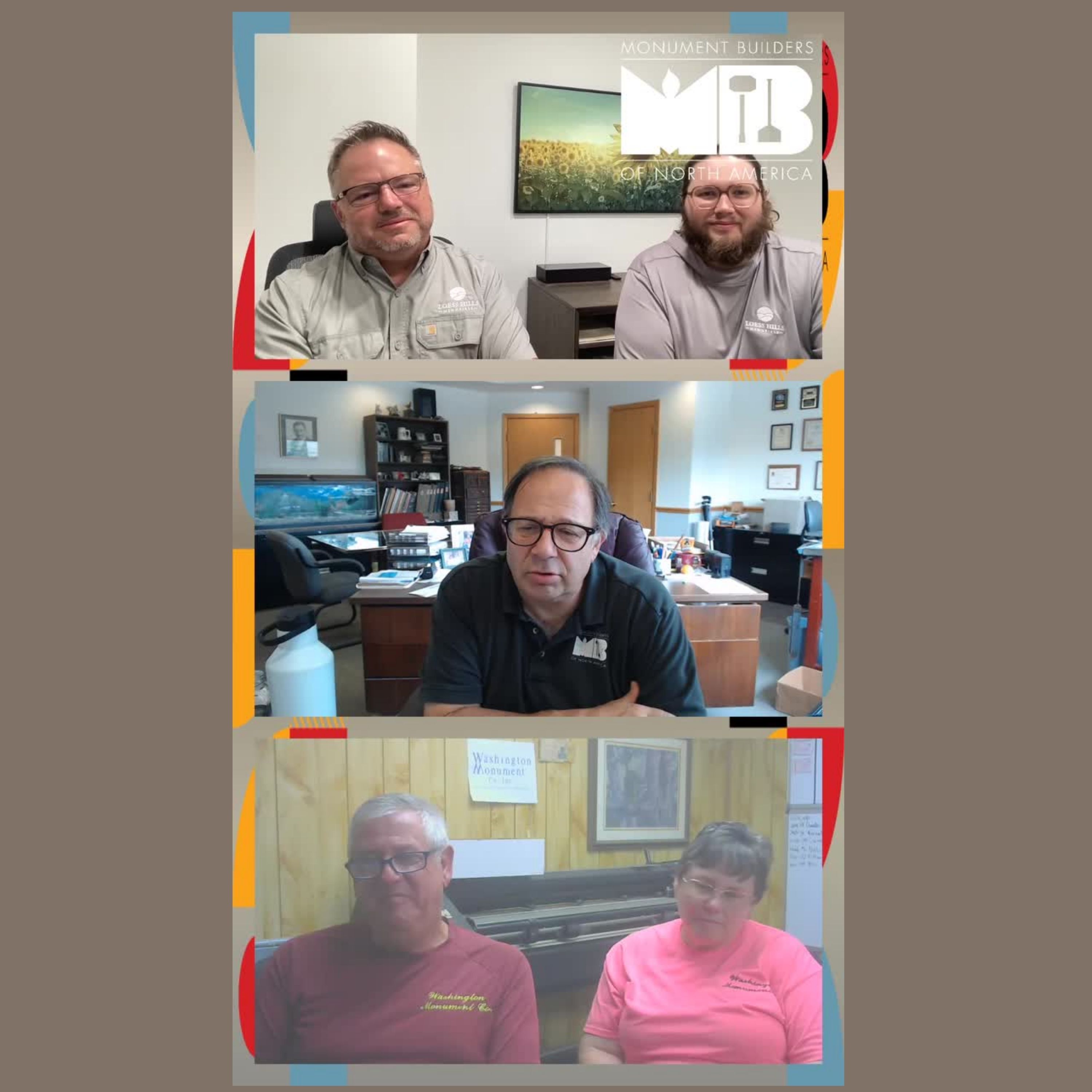
And joining us today to discuss this fascinating topic, I have the honor of welcoming four fellow certified memorialists.
Allison Ramer, cm, co owner and CEO of Emerson Monument Company in Springdale, Arkansas, and past president of mbna. Morning, Allison.
[00:01:03] Speaker C: Morning.
[00:01:04] Speaker B: Mark Coward, cm, Division Manager of Columbus Marble Works, Columbus, Mississippi. Mark is the president Elect of mbna. Morning, Mark.
[00:01:14] Speaker D: Good morning.
[00:01:16] Speaker B: Next, we have Joey Furstenberg, cm, president and owner of Vancouver Granite Works out there on the west coast in Vancouver, Washington. Good morning, Joey.
[00:01:25] Speaker D: Or Mike.
[00:01:26] Speaker B: And finally, last but not least, Troy Caldwell, cm, aica, co owner and general manager of Caldwell Monument Company in Kokomo, Indiana.
[00:01:37] Speaker D: Good
[00:01:37] Speaker B: morning, Mike.
[00:01:38] Speaker D: Good morning.
[00:01:39] Speaker B: All right, so hello, everybody, and welcome to today's podcast.
This is where you say how great it is to be here with me.
Always
[00:01:49] Speaker C: great to see you guys.
[00:01:50] Speaker B: Absolutely. And thanks
[00:01:52] Speaker D: for having us, Mike.
[00:01:53] Speaker B: Well, it's a pleasure to be a part of
[00:01:55] Speaker D: Hollywood Squares,
[00:01:56] Speaker B: right? Exactly. Exactly.
For the block I go with Mark Coward. Okay.
Anyway, to understand why this group is with me today, I want to bring your attention to a news article published in 1976 by MB News titled 200 Years of Memorialization to Commemorate the U.S. bicentennial.
That was back in 76. That article not only looked back, but it made some predictions. And here we are 50 years later, and the November Trends issue of MB News looked at those forecasts.
So, Alison, please share with us what monument builders in 1976 thought the industry might look like in 2026.
[00:02:45] Speaker C: Absolutely. So in 1976, they made some really bold projections. The first projection that they made is that monuments will be less stereotyped and less impersonal, so they would be more individual and artistic. They also said that they thought that monuments would be marked by lines that depict movement in the stone, so we would see a lot more movement and motion in the monuments that we make.
Interestingly, they thought that horizontal monuments would become the most popular monument that we sell.
They said bronze markers will persist with only minor altercations from how they existed in 1976. They said that architectural elements from ancient Greece would continue to serve as prototypes. And this next one, guys, I am not even for sure what this is. I read it and I thought, what in the world? They said that the screen, quote, unquote, the screen will be more curved than flat.
Does anyone know what the screen is? Because I didn't know what the screen was.
I asked a few people and they didn't know what the screen was either. So y' all feel free to pop in there and tell me what you think.
[00:03:56] Speaker B: Troy, you
[00:03:57] Speaker C: want to
[00:03:57] Speaker B: try that one?
I do not. I don't know what the reference of screen means.
[00:04:04] Speaker C: You don't know either. That makes me feel better. Troy.
[00:04:07] Speaker E: Yeah, I thought that that was referring to just a tablet. Just a horizontal tablet. Another term for that.
[00:04:14] Speaker B: Yep. I think, Joey, that's where I would have gone.
I know back in 76, one of the popular industry terms that we were trying to get away from was die. Another word for tablet. Right. And so I think that's where the use of screen was starting to come into vogue. So, yeah, the top piece of a two piece memorial. I think the screen is where you're at, Alison.
[00:04:41] Speaker C: Okay, that makes total sense. Another projection they made that was interesting was that they said monoliths will be very popular. And they said that they thought monoliths may replace the horizontal tablet as the dominant monument form in the future.
I thought that was really interesting.
They thought the pedestrian appliques, so I'm assuming they're talking about components that were placed in the corners of the stones, would be absolutely gone. And they also thought panels would be gone as well.
They said that granite, marble and bronze would be the primary memorial medium.
And lastly, the last projection is that memorialization is on the threshold of, quote, unquote, a new golden age.
So those were the projections in 1976.
[00:05:34] Speaker B: Fabulous.
So let's talk about how memorialization has changed in the last 50 years.
More personalized monuments is one point that 1976 got right. What's commonplace now that would have been impossible 50 years ago?
I would
[00:05:53] Speaker F: say probably the personalizations through etchings that came on in the 80s and just has built momentum since,
[00:06:03] Speaker B: certainly.
What else? Maybe not impossible, but what is much easier to perform today in terms of monumental expression?
[00:06:14] Speaker E: Well, I think just putting additional text on things just as a baseline.
Fifty years ago, everything was done by hand. You were cutting everything on the stencil by hand.
Today you're just typing it in and Lauder cuts it for you. So it's a whole lot easier to get long poems and that kind of thing onto oddment.
[00:06:34] Speaker B: Okay, so text, we see more text today. Okay.
[00:06:39] Speaker D: The stencil process and installation cranes are much more common now to help with installs.
[00:06:47] Speaker B: Absolutely. I remember when I first started in this business a few weeks ago, we were, we were sliding tablets and bases off the side of the truck onto tires or soft and, and moving with four wheel dollies or rollers, that kind of thing. So it was much more Labor Intensive even 50 years ago. And you're right, whether it's a stick boom or knuckle boom, advances in technology have really made, and it's interesting because it's made moving heavy stones more easy or easier.
But at the same time, we've seen the trend kind of away from those really, really big projects. So just kind of an interesting dichotomy there.
[00:07:40] Speaker E: Yeah, I remember we had our pickup truck when we had this thousand dollar little electric hoist that was state of the art back in the 80s and, and now, you know, we have, you know, 5,000 pound boom on our truck.
Interesting to note that what we've found is a lot more monuments that we sell.
You know, we've been able to, because we can lift bigger things.
We are not afraid of the bigger things because we're not afraid of breaking our backs and such like 30, 40 years ago.
[00:08:14] Speaker C: I think one thing that's more commonplace now is idea generation. The clients are bringing in AI generated memorials that, you know, pictures that they've generated and they're viewing other ideas that people have created and put in the cemetery online. So it's easier for them to search for a monument for someone who enjoyed golf, for example, and find tons of ideas of golf memorials. And they bring those into us to serve as the foundation for their idea. And we can build on that further as professionals. And that wasn't commonplace 50 years ago or even available.
[00:08:52] Speaker B: Yeah, right. I think that technology, you know, that phone that you hold in your hand today represents a change of our entire culture. You know, I remember when you'd be sitting around with friends and someone would ask a question about, you know, whatever it was, and you'd have to wait until the next time you were together that someone might have found an answer. Now it's right there, right now.
It's just, it's completely different.
But I think too that the speed at which information is available to us also can negatively impact our industry. Right. Because I think that people, even though there's a lot of ways to streamline the process today that we didn't have before ways that the labor involved has been saved make people feel like the process should be quicker than it is.
And I think that we have to remind people often that this is still a craft. We are still craftsmen. Producing people pieces of art that are individual for our families. And fast isn't always the answer.
So the speed with which society moves today can. Can often work to our disadvantage, I think.
Anything else. What else did 1976 get right in their predictions?
[00:10:28] Speaker F: Well, the one thing that comes to my mind is personalization across the whole gamut.
Hardly ever do we do a memorial that looks like a 1976 memorial these days with just year dates and no design and simplified lettering.
[00:10:48] Speaker B: Yep.
[00:10:49] Speaker F: So all those things are being changed constantly.
[00:10:55] Speaker B: So the, The. The forecast said that monolithic shape would become dominant. Why do you think that that didn't happen?
[00:11:03] Speaker D: It's really this.
In reality, I guess it's the same whether the monuments turn horizontal or vertical.
But I envision more space when something is horizontal. You've got a side for the husband, a side for the wife, and you can customize each side where it doesn't seem the same to me. When it goes vertical, you cover both graves.
At the time, cremation was such a small part of our business, where now, of course, it's more common. But I think covering. We still have people that envision the monument covering both graves when you have a traditional burial. And they'll ask, well, this isn't centered right over his grave. Well, no, you would have to have a ten foot. In our area, you would have to have a 10 foot die to do that.
So.
So that's the only thing I can think of is just as the monument was becoming more personalized, it. They wanted a space above each person.
[00:12:14] Speaker B: Sure.
Okay. Troy, why do you think we didn't go strictly monolithic?
[00:12:21] Speaker F: Well, in the majority of our cemeteries, we are fearful of damage to the monument.
So the bases add an extra level of protection, both from grass clippings and other things.
I wonder if they were thinking that space in cemeteries would become more limited and monolithic tablets would allow them to do a larger memorial in a smaller space, which was the result of, or actually came to pass because of cremation being more common.
So using one space rather than a family plot, I think is. Is possibly what they were thinking, but without picking Eileen Mueller's mind. I don't know.
[00:13:11] Speaker B: Yeah. Okay.
Anybody else have any thoughts on why we're not seeing nothing but monoliths?
[00:13:17] Speaker E: I think some of it could also be attributed to the cemeteries Themselves.
A lot of times, families want to have what's already out there. And what's already out there is monuments with bases. And then you also get cemetery roles where they require vases involved with that as well.
So I think that plays a part, for sure.
[00:13:39] Speaker C: I think it may vary from region to region. Why we don't see it. I know that in my area, I mean, my goodness, my setting crew is not at all sad that monoliths didn't become popular because it's so rocky. But another factor that I can think of would be the expense. Usually I see monoliths being more expensive than, you know, a die and base, and I could see that being a factor as well.
[00:14:04] Speaker F: Sure. I don't know. It's an interesting as. As you mentioned, region is a huge influencer in our industry, I think. And while you go to monolith being more expensive, to me, I thought, okay, monolith might be less expensive because now you're dealing with one piece instead of two
[00:14:30] Speaker B: pieces.
So, you know, it's, again, regional. Looking at the. The same situation, you know, we don't always come up with the same observation or solution, for sure.
All right.
So use of
[00:14:47] Speaker F: a
[00:14:47] Speaker B: variety of materials was also forecasted,
[00:14:49] Speaker F: you
[00:14:50] Speaker B: know, in order to produce more artistic memorials.
[00:14:53] Speaker F: Do
[00:14:53] Speaker B: you see that happening today in your areas?
[00:14:58] Speaker D: Absolutely.
[00:15:00] Speaker F: Yeah.
Okay.
[00:15:01] Speaker D: We see everything from granite and marble to bronze and porcelain. I mean, it's just kind of unlimited now, things people are using or attempting to use.
[00:15:16] Speaker E: Yeah. We even had some stainless steel that we've used for monuments as well.
At least onto a granite monument. We will stay clear of marble on our neck of the woods, because with all of our. With our weather.
[00:15:30] Speaker B: Yeah, yeah.
[00:15:30] Speaker E: Marble can really erode away.
[00:15:33] Speaker B: Okay, Troy, are you seeing a mix? Are you seeing a change?
[00:15:39] Speaker F: Yeah, definitely. It's almost as if the public wants it to be different than what it was 50 years ago, and they're looking for that in the materials that we use.
So they're constantly saying, wow, that's a really neat color. And the imports have kind of driven the availability of those imports over the last 50 years.
Increasing has driven that color palette available to us.
We do a lot of things with glass. We've enjoyed employing that into our system a little bit with stainless steel and bronze and. But we are stone guys, so we definitely like different stones and different textures on this stone.
[00:16:28] Speaker B: Right. So in terms of materials, I think you're right.
We. We too. And mostly because of cemetery regulation and restriction, do very little marble, almost no marble that I can think of so granite and bronze, or granite and glass, or granite and porcelain are some of the combinations that we see more and more frequently in what we're providing for families. And I don't know, it's hard to go back to the chicken or the eg. Right. Is it that we are able to produce these materials in a way that they're more appropriate for cemetery memorials, or is it that the. The desires of the family for something beyond the standard granite is driving the market to create these additional outlets? You know, I don't know which came first. I think it's kind of a combination, you know.
Allison, what about you?
[00:17:34] Speaker C: I see a. Like Troy, I see a lot of families requesting materials that be added to their memorial. Glass, bronze, bronze adornments or bronze lettering, stainless steel mark. We see some porcelain or the enameled stainless that can be printed on.
So we see a variety of that as well.
[00:17:57] Speaker B: Right. Do you see much of a inquiry for materials that would not be appropriate? Is anybody asking you to do things that just don't really fit the bill?
[00:18:10] Speaker D: We get a fair amount of requests for sandstone, which we just stay away from long term. Sandstone is common in our area as far as naturally occurring sandstone, but it's just so soft. And, you know, we. That's one. We stay away from that we have a lot. A fair number of requests for.
[00:18:33] Speaker E: That's the one thing we get requests for is somebody can have a countertop put in and they'll try to come in with a inch and a quarter piece of stone and want to make a flat marker out of that. And we encourage them not to do that, obviously, for reasons of it breaking pretty quickly being out the cemetery. But that's probably the biggest thing that we get that we try to steer people away from.
[00:18:57] Speaker C: Do you think they're attached to that countertop, Joey, or do you feel like it's more for cost purposes? I
[00:19:02] Speaker E: think it's more of a cost purpose. They're trying to save some money, and then in a couple of years they're going to be replacing that because it broke.
[00:19:11] Speaker B: Sure. Yeah.
[00:19:13] Speaker F: Makes a good temporary marker, but not a permanent,
[00:19:16] Speaker E: right?
[00:19:16] Speaker B: No, for sure, for sure. And it's been interesting to see, you know, over the. The last 50 years, the, the. Just the granites themselves and not so much. And, you know, the import market has really exploded over the last 20 years, I'll say, in terms of variety of color and shape and so on.
But in my market, there's a real concern about consistency. You know, we have cemeteries still that are actively interring on 20 and 30 grave family lots. And so being able to provide a headstone today and being able to match that headstone 10, 20, 30, 50 years from now is a real concern.
And it's interesting to find that, you know, some of the, some of those colors that we were adamant were going to be here for the long haul over the last few years have not quite panned out like we anticipated.
So that's the, you know, the other side of that coin for sure.
So, all right, so we talked about materials. Okay, so how are things being produced today?
What are parts of the manufacturing process today that are allowing us to be more creative?
Mark, I think you'd have a pretty good handle on that. What are some things that we can do with our machinery and our equipment that we couldn't do just 10 or 20 years ago?
[00:21:10] Speaker D: Well, the 5 axis CNC saw has made virtually anything you can design possible.
It just, I mean it will cut it, it will polish it, you know, any shape, whether you want a round ball or in the shape of a football or a golf cart or anything you can think of. I mean, it's, you know, we've had the, the contour wire saw for a long time which could do the two dimensional shapes, but now with the three dimensional five axis saws, it's just really, I don't think we've even thought of some of the things that we could do with that type of equipment.
[00:21:54] Speaker B: Yeah, okay.
Anybody else got a technology idea that's made things that in your beginning of your career weren't possible commonplace today?
[00:22:08] Speaker F: Mark mentioned the wire contour wire saw.
I know that wasn't available early in my career and that transformed what we do in the way of shaves.
Beyond that, the technology behind diamond impregnated tools
[00:22:24] Speaker B: sure
[00:22:25] Speaker F: certainly advanced a lot of what we do in all aspects of our manufacturing.
[00:22:30] Speaker B: Yeah, industrial diamonds have made a huge impact. I think I remember when I first started polishing larger pieces of stone. We were using loose abrasive and steel wheels to polish. And now you've got industrial diamonds and compounds that really have changed the speed with which you polish. And not just the speed, but the smaller pieces with smaller wheels and angle grinders, pencil grinders, different tools like that. Just the smaller type pieces that you could polish today that were way too time consuming to think about before for sure.
[00:23:14] Speaker D: Design side of it has changed drastically as well. You don't have to have an artist sketching out every single little change that you can see with all the different CAD type computer based design software.
It makes it easy to play. I find myself at night, sitting, watching tv, just playing around, even with shapes and just almost like doodling. But it's on the computer.
[00:23:41] Speaker B: Sure.
[00:23:42] Speaker C: Thank goodness. Because nobody appreciated my stick figure flowers.
[00:23:46] Speaker D: Yeah.
You know, challenged as well.
[00:23:50] Speaker B: I would, I would challenge that statement because I think that and, and this is, you know, my sister and I get into this debate a lot.
I think as technology advances, I still think being able to sit down with a piece of paper and a pencil, no matter how rudimentary your sketch is, it's something that you're creating out of nothing. And I think people still sit there with more respect for that kind of creativity than someone manipulating the keys on a computer to, oh, here's, here's our hands, here's our flower. Boom, boom, boom. Oh, we can make it a little bigger, we can make it a little bit smaller.
So, yes, I think technology is really great in that respect.
But the basics, things like proportion and understanding how the elements are supposed to fit together in an artistic way is still a core principle that the technology can often mistakenly replace.
And so it's difficult for a lot of folks to understand that just because you can do it doesn't mean you can do it well. So understanding the differences, I think becomes more important and not less important today.
[00:25:21] Speaker F: I totally agree.
[00:25:23] Speaker B: Thank you. I appreciate that feedback.
That's, you know, it's hard.
[00:25:30] Speaker D: I find myself still drawing the stick figures, especially determining, you know, which way does the monument face. Who's on the left, who's on the right? Is it facing east? And so, of course, I draw the, the box with the line down it for the two graves, and then draw the stick person there.
You know, the head is here, the feet are here. And of course, I apologize when I'm doing it, but I don't have that natural artistic drawing ability.
[00:25:59] Speaker B: Yep.
Now, I, I, I can think back to some of the early contracts I wrote up with this little squiggle here. Yep, those are your praying hands. Now, don't worry, it doesn't look like praying hands here, but once we get a full size drawing, it's going to look exactly. This is going to be, here's your cross with some flowers and people. Yeah, I could say, okay, I can see that. And I'm going to. This is horrible. But it's just the jumping off point. And it always was. So the creative part of our, what we do and why we do it, I think is always going to be there. It was at the turn of the last century. I think it will be at the turn of the next century, as the tools evolve, it's knowing how to use the tools and how to apply the tools to the basics of what is good design and what isn't is what's going to continue to separate quality work from the run of the mill.
All right, so last question for today.
The 1976 article said memorialization was on the threshold of a new golden age.
Did it happen?
Is it yet to happen?
Where are we? Have we hit our golden years? Joey?
[00:27:22] Speaker E: You know, I think that depends on how you measure the golden years. I remember when I first got into the industry, they were saying, oh, the death rate's gonna. We're gonna have all these people that are gonna be passing away because of the baby boomers. And, you know, we certainly have increased as far as that goes. You know, the COVID year certainly provided a bump as far as the business aspect goes for those couple of years when we were battling that stuff.
But, you know, if you're defining golden age, as far as the number of stones you're doing, I think that we've been there. If you're talking about the golden age, as far as how we're designing and what we're doing, I. I think, you know, it's kind of how you look at it and moving forward, I think, you know, we could continue a golden age, or we've already had it, we're morphing into the next one. So I feel like, you know, it's how you look at it and how you're moving forward in it and how you're measuring things, whether or not we're there or not.
[00:28:16] Speaker B: Okay, Troy.
[00:28:18] Speaker F: Well, Joey, put that in better words than I could ever imagine.
[00:28:23] Speaker B: Did sum it up pretty well,
[00:28:25] Speaker F: I would say, for me personally, having only lived in this 50 year period that they're talking about, I've enjoyed the ride. I mean, it's been the most amazing way to invest my life. I love the.
The all aspects of this business, and it's been a fun ride. What it is in the next 50 is yet to be determined, but I constantly enjoy seeing young people come into the industry with high expectations and great hope. And I encourage that every opportunity I get. And I. I just love what it's done for my life, and I hope it does that for the next 50 years.
[00:29:06] Speaker D: Unlike I think most of y', all, I didn't. I didn't grow up in this industry. So when I was a little kid, I never dreamed one day I want to make headstones. That never entered my mind back then.
So as Troy was saying, I mean, I think it's almost. This industry is almost a calling, and I think it would be miserable to be in this business if you didn't really love what you do.
That would be difficult. But as far as the Golden Age, you know, I look back a hundred years ago at how ornate these monuments were, and they're all created by hand. Someone there sat there and chiseled every little detail on that monument.
So I think we have simplified it in a way. I hate to say that sounds. Because they look. They're. They're busier now and have a lot more detail, but I think that it's a much simpler process now. I don't think as much overall, I don't think as much emphasis is put on a monument as it was. But I'm going back more than 50 years ago because I don't really think that there's a lot of difference in the last 50 years as far as the emphasis on a memorial.
So that's a hard one for me. I wasn't in this business 50 years ago, so.
But just from what I see historically, in one way, we're in the go. We've been in the Golden Age, and in other ways, I don't think we are. I don't think there's the emphasis on memorialization that there used to be.
I think it's more of a. Of a.
A necessity. People view it more as a. Something you. You're supposed to do. We need to go get a headstone because so and so passed away.
We still have the exceptions to that, thankfully. Because I think that's probably what drives. All of us are the ones that do care and do focus on it.
[00:31:09] Speaker B: All right, thanks, Mark. Allison, Is it here? Was it there? Is it coming?
[00:31:15] Speaker C: I don't know. I agree with Joey. It really depends on how you define it. What that golden era was, was. In a way, I feel like the golden era was during the Victorian era, when people were going out and recreating in the cemetery, and that was like a cultural norm. And we had these ornate monuments that Mark was discussing. I mean, go to a Victorian cemetery and your mind is just blown by all of the artwork out there.
So in a way, I feel like the golden era was Victorian days.
But then with the ease of making memorials and the ease of personalizing them and pitching them to families and really doing our craft, I don't know. I think maybe we have more yet to come, especially with the ability to integrate digital options into standard stone memorials. I don't know. It'll be really interesting to see what comes.
[00:32:09] Speaker B: It will be.
I think you're right. I remember my dad telling me stories about my grandfather saying that the business was never going to be to my father what it was to him. You know, the memorial parks were on the rise, and there was all these changes coming that were going to be the downfall of the monument industry. And I look back at what it looked like for my dad, it was certainly different than it was when my grandfather was in his prime.
And it's certainly different for me than it was when my dad was in his prime.
And it will be different for my son as he grows into this business.
But I feel with all my heart, well, there's two things. One, I want to.
I did a recently did a presentation on my grandfather and his design work for AICA a couple of weeks ago.
And I pulled out an article where he was quoted in about 1985.
And he said that the onus is on us, the monument builder. If we want monuments to continue to be relevant and important, important to families in the future, we need to continue to design memorials that are going to be relevant and interesting to folks in the future.
If we don't help the customer and we don't drive the bus and show them what's possible, then we are going to be the end of the monument business as we know it. It's not going to be the family that drives that. It's not going to be the cemetery that drives it. It's going to be us.
So we can be the best friend to our future customers or we can be our own worst enemy. It just depends on how we look forward to it. And if my son feels like the best years of the monument business were in my time or my father's time or my grandfather's time, what is he doing here?
Seriously, he needs to be able to look forward in a way that he sees goodness for him and what he does and the families that he serves along the way. And if we can't do that collectively, if we're all doom and gloom, we thought, oh my gosh, here comes cremation. It's going to be the end of the monument industry. No, it just made us pivot right.
We may pivot slowly.
I'm not going to lie. We all know it. We are not the most innovative and fastly remembrances. It's okay if we change slowly, but we have to continue that relationship.
What do you think this 1976 forecast missed?
[00:35:23] Speaker C: Well, there's three things that I feel like the 1976 forecasts missed. First and foremost, they missed cremation, which I found to be really interesting that this article did not mention the rise of cremation whatsoever. So I thought that was fascinating. The second thing that I thought was interesting is that they didn't discuss at all how the region can impact changes. I know that, you know, myself and Mark being in the south, you and Troy and Joey being in the north, the issues that we face down here are going to be much different than the issues you face up there as far as cremation goes, as far as what the cultural norms are for memorialization. And the last thing I think they missed is the topic of technology, which we've touched on just a tiny bit in this podcast.
But absolutely, technology's changed the way we design monuments, market monuments, pitch monuments, make monuments, install monuments. It's impacted everything. And I don't think they realized exactly how much technology would impact us today.
[00:36:25] Speaker B: Yeah, I don't think we had a clue how technology was going to change, not just our industry, but every industry, every aspect of our life. And as technology evolves, this, the time it takes to change is just cut in half and in half and in half. So that, you know, what we saw over 50 years technologically, we're now seeing over five years and over three years.
So, yeah, I do see that technology really changing the manner and maybe even the expectation to a degree, for sure. But again, I think that it behooves us to be on the front end of helping to write the narrative for what families should be expecting.
All right, any final thoughts before we wrap?
[00:37:31] Speaker D: Someone said just a minute ago, spot on. Is the.
I think it was you, Mike, saying that the memorialist is driving a lot of the change in his area.
You know, when you look at people like Charlie Hunt and Bot and Watson at the work they're putting out, just absolutely, absolutely incredible. And I tend to think to myself, I'm in the deep conservative south, and no one is going to buy that kind of thing. But Charlie Hunt and Tony Watson have totally blown that whole theory that they do different things. So the actual person is still the key. I think the memorialist is still the key to your market
[00:38:15] Speaker E: for sure. People don't necessarily know what's out there until
[00:38:19] Speaker D: you
[00:38:19] Speaker E: show them.
[00:38:21] Speaker D: I show them 30 Serp Top monuments, they're probably going to buy Serp Top monument.
[00:38:26] Speaker B: That's right.
That's right.
All right, so with that, I think it's time that we. We close this. This installment of our part two as a. As I said this is a special two part episode of Monument Matters podcast. Today we looked at the past 50 years so I want you to join us for the next episode where we will forecast the next 50 years to give monument builders a glimpse of 2076 and something to discuss there. Now I Spoiler alert. We're not going to be talking about lottery numbers or anything like that.
It's going to be strictly the monument business and how we see things changing. So I encourage everyone to read the November Trends issue of MB News for the full article with additional insights from certified memorialist Don Calhoun, retired owner of Create a Legacy in Stone, and Michael Feinberg, lead designer at Milano monuments.
Again, MB&A invites you to stay connected Through Facebook and LinkedIn, or visit us at www.monimalbuilders.org for upcoming events and webinars for MB&A Monument Matters. I'm Michael Johns. Thank you for taking time out of your day to listen in. If you found today's content worthwhile, and I hope you did, please share the link with a friend. Your comments and feedback are important to us.
We'd love to hear from you. So please drop a note to infoonumentbuilders.org and again, don't forget, part two will be dropping soon.
So thanks and have a good day.
All right.