Episode Transcript
[00:00:05] Speaker A: Welcome to Monument Matters, a podcast produced by the Monument Builders of North America for all things memorialization.
Each episode is an extension of our monthly magazine, MB News. Monument Matters invites everyone to listen and share. You'll find all of the episodes on Apple, Spotify and YouTube.
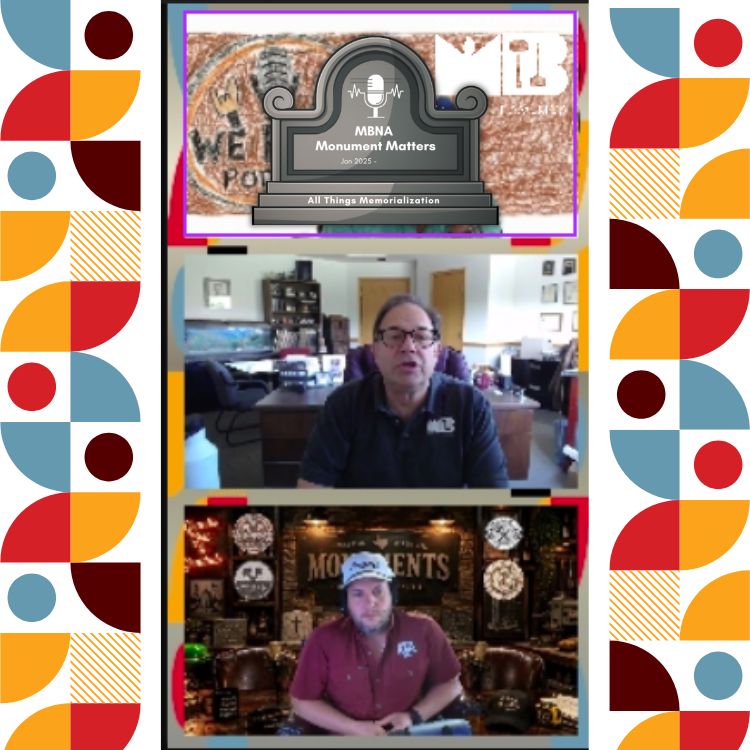
[00:00:25] Speaker B: Hello and welcome to season two, episode four of MBNA's Monument Matters, a podcast produced by the Monument Builders of North America for all things Memorialization.
I'm your host, Mike Johns, CMAICA from the Johns Carabelli Company, Cimarano Monuments and Flowers in beautiful Cleveland, Ohio. I'm also a past president of Monument Builders of North America.
MB&A is 119 year old admission is to define and promote memorialization in a viable, innovative and diversified way for its members and to enhance awareness of memorialization by the general public and the entire remembrance industry.
In the spirit of promoting memorialization, the MBNA Marketing Committee has created this podcast as an extension of our monthly magazine MB News. Each podcast episode features a discussion of related to a magazine theme. Monument Matters podcasts invite everyone to listen and share. You'll find all of the episodes of our first two seasons on Apple, Spotify and YouTube.
Today's episode is titled why Burial Still Matters.
So please join me in welcoming my friend and colleague Christine Bokamp. Cm. Christine is the Director of Marketing and Business Development at Hatton Monument Group in Grand Rapids.
She's also the President of Wind MBNA and Chair of the MB News Editorial Advisory Board. Christine, hello and welcome to our podcast.
[00:01:58] Speaker A: Hi, thanks for having me.
[00:02:00] Speaker B: It's a pleasure. Always good to talk to you.
So, in our last episode. Ooh, sounds like a cereal, right?
In the March issue of MB News, Dr. Tanya Marsh shared research showing that while cremation rates continue to rise, many consumers still rank burial among their top preferences.
Who knew?
That raises an important question for monument builders. If burial still matters to families, how do we present it in a way that resonates today? Christine yeah.
In your article in MB News, you challenge the assumption that cremation growth automatically means burial decline.
What prompted you to write this article and what message were you hoping monument builders would take away?
[00:02:48] Speaker A: Well, it's something that's been stirring me for quite a while, actually. So I've done quite a bit of work over the last eight years directly with cemeteries, helping them understand the memorial side of cremation burial things like changing size restrictions and accommodating for, you know, larger monuments, personal, you know, columbarium, things like that. And of course, you know, regular columbariums. They've become very Popular. So anyway, more recently was having conversation with cemeteries who were very excited to add big columbarium. And it was all about the space saving aspect and about the sort of maintenance aspect. And I mean, I've been pushing back a little bit and trying to challenge them to think about maybe what their community actually wants.
I challenged one to actually take a survey, and they did that. And what they found was that people actually didn't want a columbarium. They wanted green burial. And they were pretty surprised.
So I think just that that challenge has prompted me to write something.
Because there's a big span between those two things, you know, between cremation and green burial and. And monument builders kind of sit right in the middle of that, you know.
[00:04:05] Speaker B: How so?
[00:04:06] Speaker A: Well, I mean, because with cremation, the majority of cemeteries want to put in columbarium. We're not building monuments. And for those with green burial, there are a lot of restrictions on what kind of marker can be or if any can be placed on a green burial grave. It's more of a prairie like situation.
And so that's been my experience. So to me, it has felt like were kind of cut out of the conversation.
So anyway, that's kind of what prompted me on this. And I guess what I hope monument builders take away from this is just that our voice actually does matter. It's just that nobody's asking us, which means that we kind of collectively have to insert ourselves into this. But I think we can do that within the cemetery situations and in the public.
[00:04:56] Speaker B: Yeah, I think you're right.
And I think it's incumbent on us to actually do just that. People don't know what they don't know. I'm rolling in my head some more questions and how does that look for me? And so on and so forth. Green burial is not really something on our radar yet in my market. Although I'm sure it will be in the very short term. At least not in any appreciable way right now.
So for you, how much of that are you seeing at Patton? Is burial disappearing altogether? What are you doing about memorialization when it comes to green burial at this point?
[00:05:34] Speaker A: Well, in my area in Michigan, we've always had a pretty high cremation rate, pretty low green burial rate. I have worked with cemeteries to develop stones. Again, you have to. You have to insert yourself into the conversation. Like when a cemetery tells me that they are thinking about adding a cremation or I mean a green burial or a forest burial area, I am the one that has to step in and say memorialization is still important.
Here are the options. Here's something that looks very natural and yet it is still durable granite. And there is still personalization. And you can still handle it with maybe a dolly, a hand cart, you know, so that we don't have to drive equipment back there. So it's just, it's finding those ways. And as far as cremation, cremation, when I first experienced the surge of it around here, it was somewhere between like 2005 and 2008. Like it always existed, but there was this giant surge of it. And I'm not exactly sure why, but we did see a pretty big drop in monument sales. So burial felt like it was kind of disappearing. Then there was like this uptick in people realizing that you can't just hold on to ash ashes either. So then they were sort of like, you know, that's not a long term choice. What are we going to do with it? And so they wanted to bury as many ashes as possible in a single grave.
So around here we see regulations. Pretty average, two to four ashes per grave.
We have a couple of cemeteries that are up to 12.
So then I would go into the cemeteries and say, hey, can we get some ordinance changes on size regulations? And, and I realized, you know, that these are municipal cemeteries. Right. I can't lump all cemeteries together, obviously, but I'm in an area where I have a little bit of influence, luckily. So I would go in and. And we'd say we need bigger monuments, you know, because otherwise there's. There's no space. There's no spaces for names, design, creativity, personalization. So cemeteries aren't in love with this either. And so now they all want a big giant columbarium plopped down in the middle of a field. So now my battle, I chose the battle, I realized, but I, you know, now I go in and I say, okay, well, how can we make this space really nice?
But more than that, how can we incorporate other forms of burial in your space? And that's, that's a whole long conversation. But I've done quite a bit of work in that too, to the end of even being able to help design a cemetery, which was a huge honor.
[00:08:15] Speaker B: Sure.
So, you know, I think that on the surface, Green burial sounds like a great idea, you know, if you're concerned about the environment and so on and so forth. And I'm just not discounting that by any means, but I think that we have found over and over that memorialization of some kind is a really critical component component to the life cycle and the, the cycle of grief. Right. It just helps with closure for so many families. And so I just wonder how, as green burial becomes more and more popular, just how we deal with that aspect for those families. Sure. And I don't expect you to have that answer right here right now. But I think that's one of the things, you know, I think that we're accustomed to looking at things a little bit differently than most folks. We, we tend to play the long game because our product is made for the long game. Right. It's made to be there forever.
And so that's kind of how we look at these problems and these opportunities, these situations where a lot of folks just plain don't. Right.
[00:09:31] Speaker A: Yeah, exactly.
[00:09:33] Speaker B: So I know you recently talked with other monument builders at MB University in Fort Worth. Anything that you've heard from other members on the topic?
[00:09:41] Speaker A: Yeah, I mean, I cornered a few people that I knew were from different areas than I was. And I think that.
Well, first of all, you know, cremation rights vary so much. The swing is like 30% to 80%. I happen to be in the 80% range, some Southern states, 30%.
So I was curious, right, like columbarium installation, what is that looking like in those areas, especially mid to lower rates and whether or not cemeteries, how they're responding, you know, with. If it's with columbarium or regulations or what. And of course what kind of cemeteries people are working in, because again, there's many different kinds of cemeteries. So in areas that had lower cremation rates, some of the major factors were actually religious affiliations having quite a bit of influence. And it wasn't that there was any sort of overtly, you know, like there wasn't, there wasn't some sort of a. This is in writing and this is what you need to do. It really boiled down to more of tradition and just following tradition. And so I would see, I saw, I saw a lot of that actually in the lower rates that it had a lot to do with religious affiliation. Also topography influences, columbarium installation quite a bit. And even full burial or above ground burial and whatever kind of internment we're talking about. And what I heard a lot of was the age old influence of who is actually running the cemetery.
Is it nonprofit, for profit, municipal? Is it a sexton run, trustee or funeral home run? Because each one we know has rules and regulations, but that means they also control language and they control public perception and they, you know, they're the ones that control costs and actually value of burial and the value of memorialization.
So I heard a lot of people just kind of voicing opinions, actually, and I don't know, maybe people were just glad to be asked. I don't know. But interesting. Yeah, yeah, A lot of influences, for sure.
[00:12:02] Speaker B: So do you believe families are being fully informed about burial and permanent memorialization options or. Or our assumptions about cremation shaping the conversation before families even hear about the alternatives?
[00:12:16] Speaker A: Yeah, I think assumptions play a really big part. So assumptions, like you pointed out, is something ecologically friendly.
You know, a lot of people still believe that cremation is ecologically friendly, and it's not. There are assumptions about whether something is economically friendly, and I would challenge that too.
So I think that public perception is guided in advertising. You know, if you're driving down the road and you see a billboard that says cremation 9 99, that's your end. All be all right there. You just made every assumption about what was going to happen.
And I think the other big, big influence is actually personal experience.
So what I mean is like, for a long time, funerals, um, they're. A lot of them are really negatively perceived.
[00:13:06] Speaker B: Right.
[00:13:06] Speaker A: People have had a lot of bad experiences with funerals as sort of this large impersonal gathering, kind of quiet, led by people who never knew the deceased. And.
And then there was sort of a turn. Right. There's a celebration of life trend, honestly, is a trend, because as you stated, you know, if we're just celebrating, we're skipping that grief process. And. And our bodies and our minds need that grief process.
That's, to me, that's just a bit of a trend. But so all in all, though, skipping the funeral has become common. Right. So it's cremation, skip the funeral, maybe burial, hold onto the ashes. But then, as we stated, we see the pendulum swing the other way where, you know, some people are coming out and wanting that green burial. That practice is fully involved, fully personal, you know, so pretty broad. Yeah. And I don't know, I think there are areas and people groups who really do value memorialization and know how to lean into their grief. So definitely not, you know, one size fits all in what I'm saying. But I do think it's a majority. I do.
[00:14:16] Speaker B: So interesting.
[00:14:18] Speaker A: Yeah.
[00:14:20] Speaker B: I think that on some level, as a society, especially since COVID we've been far less connected as a community.
And I think that also leads to that disconnection in terms of the funeral and what the funeral looks like for an awful lot of people. So I certainly understand that. But I think that, like in other areas, I think Covid is also starting to push the pendulum the other direction. Right. People are saying, you know, that was then, and I'm tired of living with those kind of circumstances. I need something more. I need more connection. I need more opportunities to give back. I need more opportunities to share and. And be part of something. So I think hopefully that's going to bring itself to change or at least reshape some of these trends that we've seen, you know, a little bit more. More positive way for memorialization.
[00:15:25] Speaker A: Yeah, I agree. And I mean, also, we've got, you know, a generation who just sort of says, scatter me.
Because with. With all of these confusing things, you know, cremation, burial, green burial, and then factors like money, religious affiliations, regul, all of that stuff.
Somebody has to balance out, you know, what they want, what they believe in, how much money they spend. So overwhelming that the answer has become, I don't want to be a burden to my family.
[00:15:58] Speaker B: Right.
[00:15:59] Speaker A: So now people are taking the least amount of effort, the least amount of ritual, the least amount of money, and it's not meaningful. It's not meaningful. So. So.
[00:16:13] Speaker B: Right. I agree. I think that, you know, I remember the days of just put me in a garbage bag and. And put me out to the curb. You know, that was the. I just don't want to. It's too much. Right. And I think that in some ways, scattering has kind of taken the place of that idea. But still. And I'm not. I. I don't mean to be diminishing the idea of scattering at all. That's not my intent there. It's just more of a. That's the. The replacement for.
I don't want to be a bother. I don't want to want to negatively impact my surroundings. So let's just. Let's just make it quick and easy.
[00:16:51] Speaker A: Yeah. Yeah, I absolutely agree. I like what Dr. Marsh said on the last podcast and that she said what people really want is flexibility, but because I don't think that the death care industry has done a really good job of defining options that we are where we are. People are either choosing nothing or disappointed by what they choose, and it just keeps perpetuating the issue.
[00:17:15] Speaker B: Yeah, I think that you're right. I think that flexibility is probably really the root. Because if you. If, again, if you put this in Covid terms, right, we had all of our freedoms taken away one way or another. We were told this is how we're going to have to manage it. This is what you can do this is what you can't do. And, you know, that has caused a lot of difficulty for people. And now you're right. I think that manifests itself. And I want options, I want choices. I don't want to be told what I have to do.
[00:17:47] Speaker A: Yeah.
[00:17:47] Speaker B: So again, you mentioned our last episode, which highlighted a surprising finding from Dr. Marsh's research that Gen Z respondents were more likely than any other generation to rank casket burial as their first choice. Does that surprise you? And how do you explain that? What are your thoughts?
[00:18:05] Speaker A: Yeah, it kind of did surprise me, but then I talked to somebody who was Gen Z, my own child, and she was not surprised at all. So I think what's actually going on here is that, you know, Gen Z is not actually enjoying the big wide world web as much as we think they are. I think that something that seemingly connects us all has somehow made us all just incredibly disconnected from actual relationships and that they are feeling it. I think what they really want is home, that they want stability and they want traditions. And like you said, I mean, we even saw it somewhat reflected during the surge of homesteading in millennials during COVID right. That turn back to that feeling of home and safety and tradition and rituals. And we cannot ignore this. Right. And I would challenge everybody out there, you know, ask the nearest, you know, Gen Z to you, you know, what is it that they want? Go ahead and, you know, do your own survey and ask people what they want. You know, it's. It's super helpful to know how to advertise. And then if you have any millennials or Gen Zs working for you, Are you listening to them?
You know, ask.
[00:19:23] Speaker B: Good point.
[00:19:24] Speaker A: Ask them. Listen.
[00:19:25] Speaker B: Yeah, if you want to know the answer, you're not going to get it without asking the question for sure.
So many families who choose cremation, as we said, still want a permanent place to remember their loved one. So how should monument builders be thinking about memorialization in a cremation world?
[00:19:42] Speaker A: Well, again, I feel like it's up to monument builders to better define memorialization. I love it when I hear a company use the word permanent memorialization. There is. There is a part of me that gets pretty irritated when I hear, like, a paperweight or a necklace or something like that being lumped into the same category as a big, beautiful monument on a grave space.
It's. It's quite irritating to me. So, I don't know, it makes me think about, like, the Victorian era, right? When mourning jewelry, wreaths made of hair, lockets, right? There were these mementos but they also had a place to go. They had a space that was meant for mourning and remembering and connecting.
And that's what I think monument builders can consider that when one. Of course, we need to have that voice in that conversation.
But.
But, you know, to know that we can redefine memorialization or we can define it better. Just that I don't know. Or also not the last stop. You know, I think that that's part of the problem too, Mike, is that there's been this disconnect between burial and cremation altogether. I know we're seeing a surge back to it, but oftentimes we're cut out, like I said before, making sure that we're separating memorialization from mementos, that we're using clear, straightforward language, no matter what our cremation rate is or any other factor. And importantly, I think that we all need to do it together.
[00:21:20] Speaker B: Yeah, I agree. I think that every life deserves to be memorialized, not just mementoized, as you indicated. And, you know, it doesn't always have to be the biggest and the most expensive monument in the cemetery or the section, just a place to go and reflect some specific connecting point, I think is the most critical thing when we talk about memorialization, you know, it's not about how much you spend.
It's about how well you're able to connect the past, the present, and the future.
And you're right. I don't think a locket really cuts it.
So if monument builders want to protect and promote burial with meaningful memorialization, what practical steps should they be taking right now in their showrooms, in their communities, or in their markets?
[00:22:16] Speaker A: Well, in my article, I mentioned that we can take a more proactive role by getting more involved in our communities. You know, I told you a little bit about my involvement, and it. It's absolutely true. You can educate your local cemetery on creating more sections in a cemetery that aren't just in a columbarium. Right. Maybe you've got that, plus you've got a section for full burial, plus you've got an area for green burial, plus some cremation plots, plus some areas in unusable areas. And you're. And you're putting cremorials on top of that, helping them realize that bringing back the idea of a family plot would actually benefit them. If you have all of these types of burial available, you are inviting a family to stay together in a cemetery. Right. And I think that people want that, and I think that if people were to ask their community that, that's really what would show up. But they're not going to do that, Right? It's good for us to go in and say, hey, this is what I'm seeing people talking about.
What are you going to do about it? Right? We don't have to go in there with, you know, with our horns on and rampage through the place and tell them what to do. You go in and you say, this is what I'm hearing, and I'm the one that are dealing with these people every day. This is real information for you to consider.
Now, I know again that you can't influence every cemetery, Right. But you can influence your community. Right? So be part of your community. It's really nice to be part of, like, chamber of commerce and business networking events and things like that. But you're going to have to go a little bit further. Those are great things.
But participation in events or sponsorship, like being connected, really connected in your community, is really important. You can hold a workshop at your place on how to clean stones in the spring. That's super, really easy way to get people in. You're not selling them anything. But now they're not afraid to be in the monument company, to be around death, to be. And the next time they need something, they're going to think about you. Or maybe they never thought about you before.
You could invite people into a writing series, you know, have people have prompts where they can do storytelling of their family and write it down. And it has nothing to do with burial or death or your obituary, but you've invited people into your space. So that's kind of what I'm focusing on this year, is inviting people into our space. And then, of course, just using advertising to educate and emphasize meaningful rituals, memorials, and that burial is not a burden.
[00:24:58] Speaker B: Yeah, amazing. It's. I always enjoy taking a few minutes to talk to you. It's always really stimulating and enlightening conversation. So before we close, let me ask you, in one sentence, why does burial, and more specifically purpose, permanent memorialization, still matter?
[00:25:19] Speaker A: Permanent memorialization matters because a grave site with a monument provides a real physical place where love, memory and grief continue.
It connects us through family history and community, and it fulfills our deepest human need, which is belonging.
[00:25:38] Speaker B: Awesome. I think there was a lot of commas and semicolons in that one sentence,
[00:25:43] Speaker A: but I think one sentence is too hard.
[00:25:45] Speaker B: Mike, I think you did quite well, and I appreciate it. And I think that I would say, you know, why does it matter?
Because every life mattered and every life needs to be reported on in some way for sure.
All right, so I think that's about all time we have for today. So Christine, thanks so much for spending time with us. The conversation, as I said, is always interesting when you're part of it.
The March issue of NB News is the Cremation issue, which features a thought provoking article by Christine. I encourage you to read it. If you have a topic you'd like to have covered in a future podcast, please leave a comment. Thanks for listening to us today, and our installment of Monument Matters. MB&A invites you to stay connected through Facebook and LinkedIn, or visit us at www.monimalbuilders.org for upcoming events and webinars. For my MBA and monument matters, I'm Michael Johns. Thank you for taking time out of your day to listen. If you found this content worthwhile, please share the link with a friend for comments and feedback. We'd love to hear from you, so please drop a note to infomonumentbuilders.org that's all I have to say this time around. So have a great rest of your day and thanks for paying attention.
You know, I'm just having so much fun.
Sam.